
You’ve been thinking about your grill wrong.
Not in the technique sense — in the purpose sense. Most home cooks light it for one protein on one day, then cover it until next weekend. One chicken breast. A few burgers. Done.
That’s a batch cooking tool sitting idle six days out of seven.
From May through August, the grill is the most efficient cooking platform you own. Higher heat than your oven. Faster than your stovetop for large cuts. And unlike both, it handles three proteins simultaneously without you standing over it. One fire. 45 minutes. Four dinners.
The only thing standing between you and cooking this way is a technique called the two-zone setup. It’s not advanced. It’s just not taught.
What professional kitchens do differently
Any line cook managing a grill runs two heat environments at the same time: a direct zone (450–500°F) for searing and charring, and an indirect zone (325–375°F) for carrying proteins through to temperature without burning the outside. On a gas grill, you leave one burner off. On charcoal, push all coals to one side. That’s the entire setup.
The reason everything you grill cooks unevenly — burnt skin, raw center, dried-out pork — is one-zone cooking. You’re running everything over the same flame and hoping for the best. Two zones fix this because different proteins need different heat at different stages. Chicken thighs need low heat to render the collagen, then high heat to crisp the skin. Pork tenderloin needs a hard sear on direct heat, then gentle finishing on indirect. Corn goes straight over the flame. You can’t do any of this efficiently in one zone.
The One-Fire Session
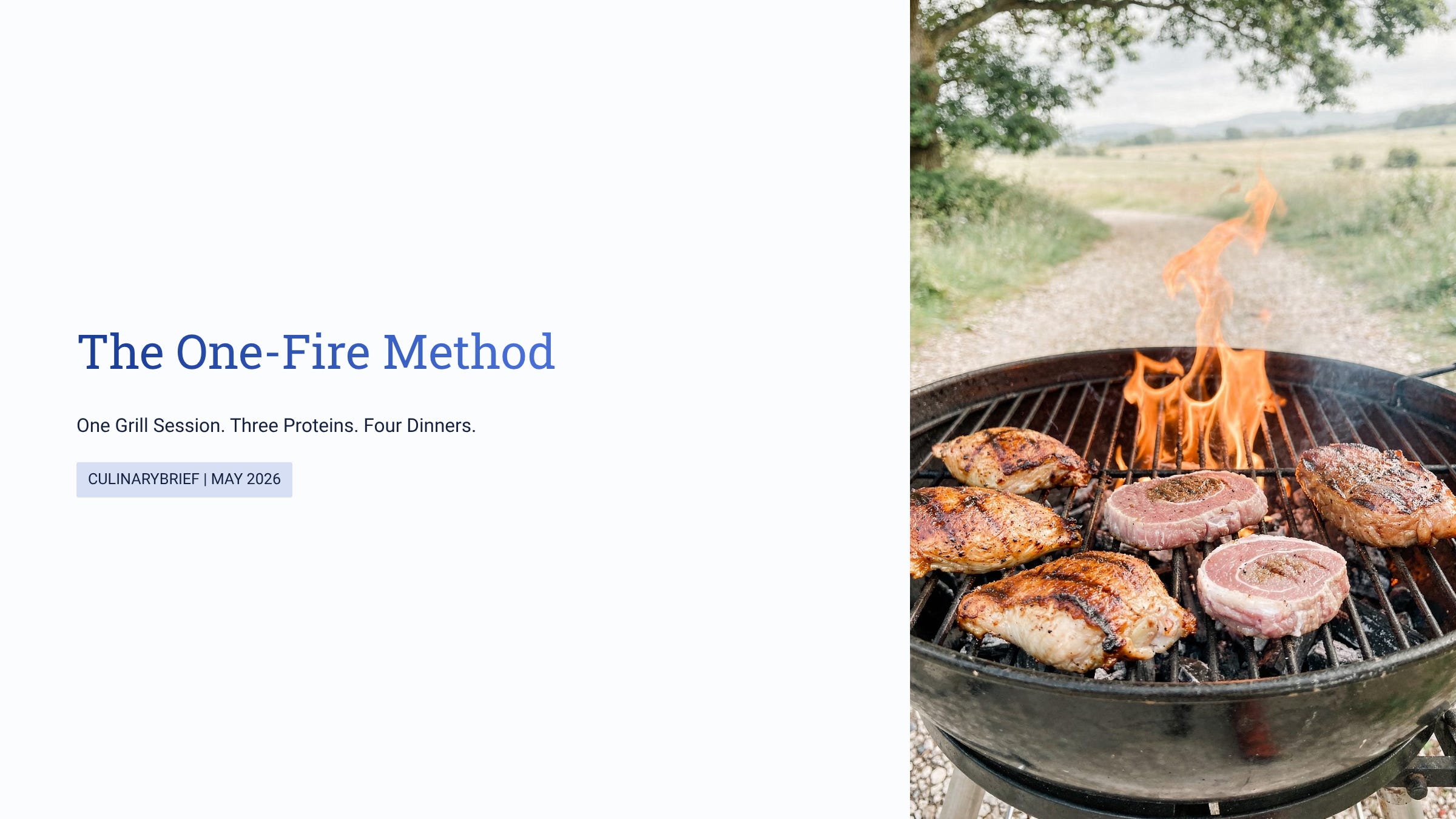
Here’s how I’d run a Sunday batch in late May with three proteins and a total grocery spend of around $22.
Bone-in chicken thighs (~$2.50/lb) These anchor the session because they take the longest. Indirect zone, skin side up, 35 minutes. Move to direct for 4 minutes at the end to crisp the skin. Pull at 170°F internal — thighs have enough fat and collagen that the higher temperature actually improves texture rather than drying them out. Two thighs are Sunday dinner. The rest go into the fridge whole and get pulled on Thursday for a grain bowl.
Pork tenderloin (~$3.75/lb) This is the most underused summer grill protein right now. Beef is up nearly 15% year over year. Pork is flat. Same technique, a third of the cost. Sear direct, 2 minutes per side on all four sides, then move to indirect to finish. Pull at 140°F — it carries to 145°F while resting. At 155°F it’s already drying out. A thermometer is not optional here.
Corn on the cob and cherry tomatoes (~$2.50 total at peak season) Corn goes direct, 10 minutes, turning every 2–3 minutes. Cherry tomatoes in a grill basket, direct zone, 8 minutes until blistered. These aren’t sides. They’re components — the base of a salsa Sunday, a grain bowl topper Monday, a wrap filling Wednesday. Blistered tomatoes develop concentrated sweetness and acidity as their skins blister and collapse. That char is flavor infrastructure for the rest of the week.


The four dinners
Sunday: Chicken thighs with charred tomato salsa and grilled corn off the cob.
Monday: Sliced pork tenderloin over rice or farro with blistered tomatoes and a quick tahini sauce.
Wednesday: Cold pork wrap with corn salsa and pickled red onion — 5 minutes of assembly.
Thursday: Pulled chicken grain bowl with whatever’s left in the fridge.
Total cost: ~$19–22 for two people across four dinners. Roughly $2.50 per serving. The DoorDash equivalent runs $55–70 before tip.
The principle underneath this
Professional kitchens don’t think in complete meals. They think in components — proteins, bases, sauces — that get deployed across multiple plates throughout a service. The batch cook version of that is the same logic applied to your week instead of your shift. Grill the components Sunday. Assemble the meals Monday through Thursday. The grill session is the prep cook. You’re the chef.
That’s the tool you’ve been covering with a tarp every Sunday night.
See you Thursday, Tyler
How do you currently use your grill — one protein at a time, or do you already batch? Reply and let me know.
P.S. The full One-Fire Method packet is attached — three marinade recipes, a grill timing sequence, all four meal assemblies, and the storage guide. Everything you need to run this session Sunday.