
You’ve eaten a perfectly seared pork chop or a piece of fish at a bistro and thought: why does this taste so much better than when I make it at home? Same cut. Same seasoning. Same heat.
The difference isn’t the recipe. It’s the last 90 seconds.
A knob of cold, flavored butter. That’s it. That’s the gap.
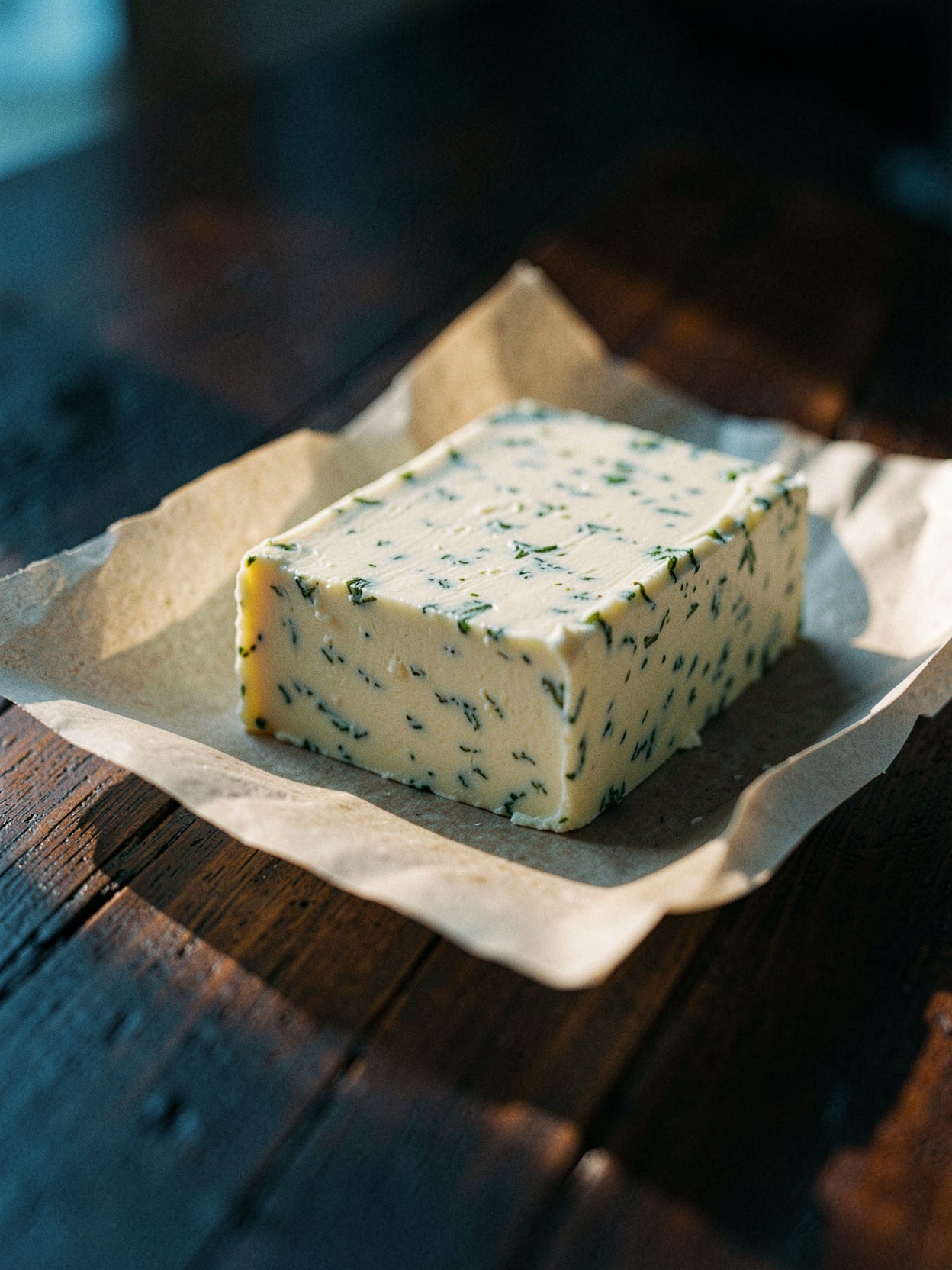
Professional kitchens call it monter au beurre — finishing with butter. It’s been standard French technique for 200 years and it’s in virtually every restaurant you’ve eaten at. The cold butter hits the hot resting protein and doesn’t just melt — it emulsifies. The fat distributes slowly and evenly, creating a self-basting effect that coats every bite in a glossy, flavor-packed finish. Plain butter does this. Compound butter — butter mixed with aromatics, acid, and seasoning before it goes in the fridge — does this and builds an entire flavor profile at the same time.
Nobody teaches this in home cooking content because it doesn’t photograph as dramatically as a finished plate. It looks like someone putting butter on food. What it actually is: a 10-minute Sunday investment that makes four completely different dinners taste like you built a sauce from scratch each time.
What compound butter actually is
Softened butter, aromatics, acid, finishing salt. Mixed together, rolled into a log, chilled. That’s the entire technique. It takes 10 minutes. It keeps two weeks in the refrigerator and three months in the freezer. And it collapses what would otherwise be four separate steps — building aromatics, adding fat, introducing acid, seasoning — into one ingredient you already made.
This week’s butter: Preserved Lemon and Thyme with Dry Vermouth.
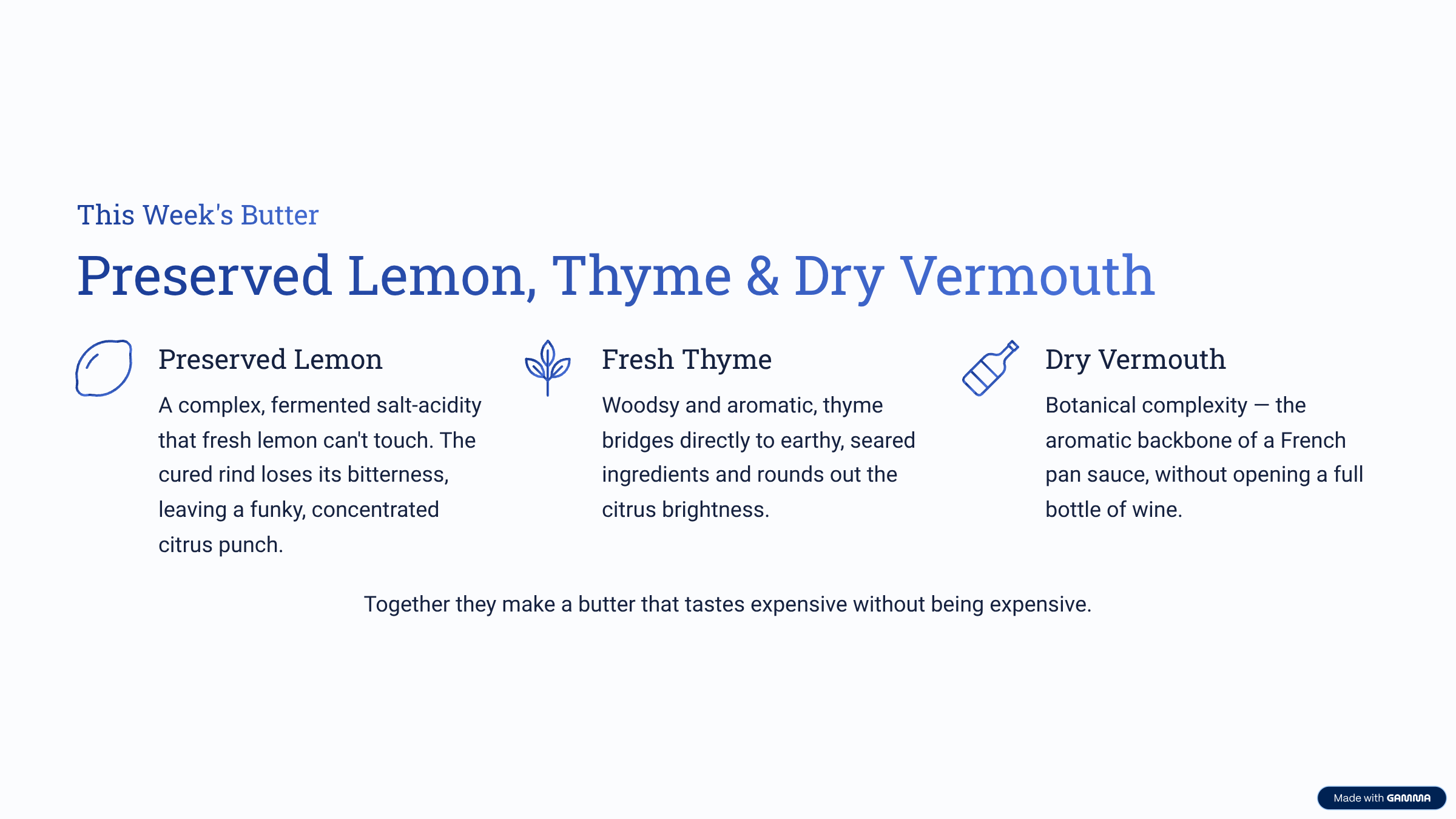
Preserved lemons cost a few dollars for a jar and bring a complex, fermented salt-acidity that fresh lemon can’t touch. The rind has been cured long enough that all the bitterness breaks down, leaving concentrated citrus punch with a funky, fermented depth. Dry vermouth adds botanical complexity — the same aromatics as a French bistro pan sauce, without opening a full bottle of wine. Together they make a butter that tastes like it took considerably more effort than it did.
The recipe is in this week’s packet. Make it Sunday. It takes 10 minutes and one bowl.
Where it goes
This is where compound butter separates itself from every other technique I’ve taught this summer. The grill batch session from last week built four dinners from one fire. This butter deploys across four completely different applications — not variations on a theme, but genuinely different dishes — from a single log in your refrigerator.
Thick-cut bone-in pork chops off the grill. Pull at 135°F internal. Rest 5–8 minutes with two rounds of cold butter laid directly on top. The butter melts as the meat rests, the vermouth and thyme cutting through the rich pork fat while the preserved lemon acts as a dynamic finishing salt that lifts the whole plate. This is the bistro pork chop. It takes one ingredient you already made.
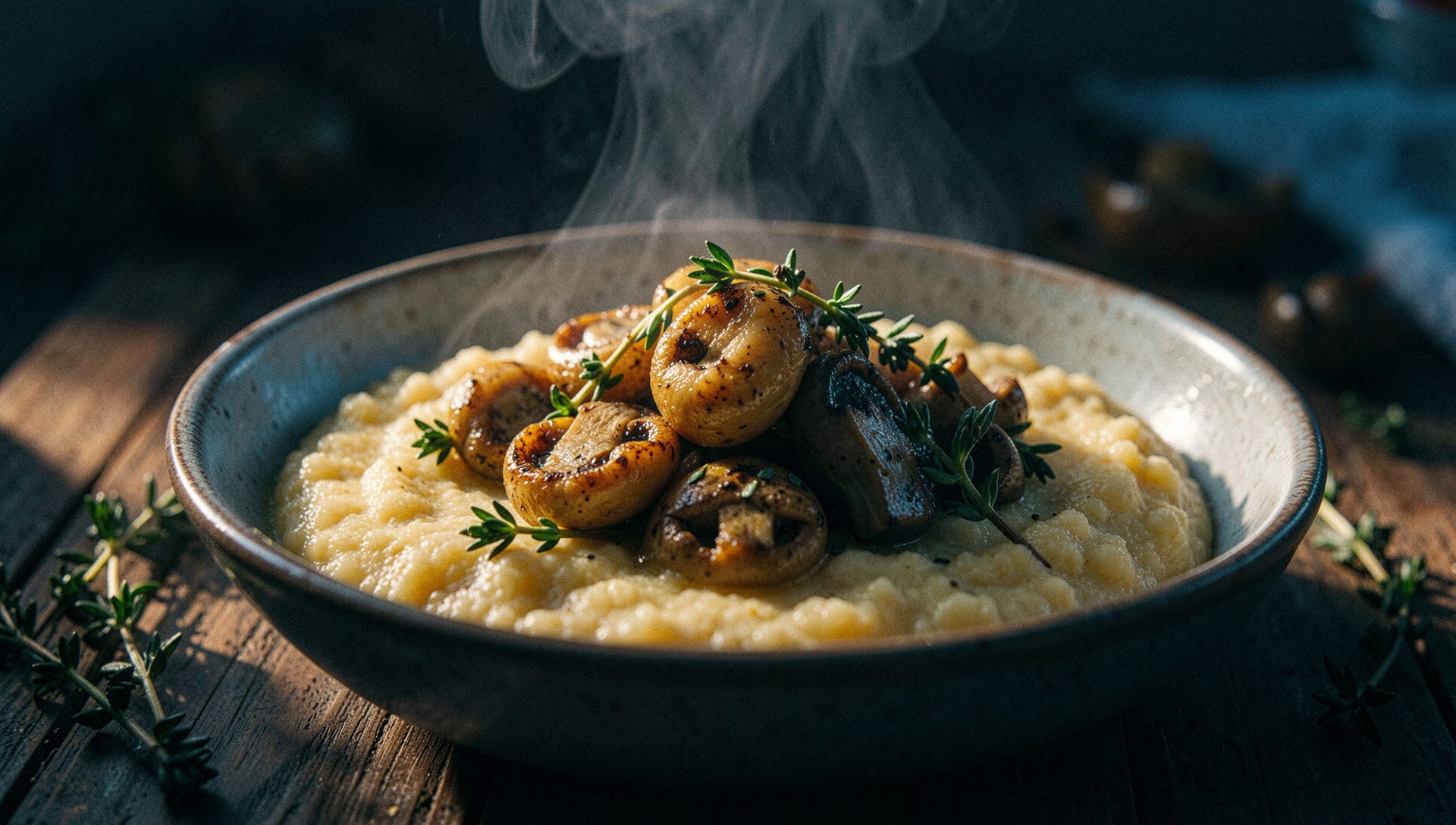
Creamy polenta with wild mushrooms. Cook your polenta low and slow until smooth. Pull it off the heat and stir in three tablespoons of the compound butter instead of plain butter and parmesan. The preserved lemon cuts through the density of the corn, the thyme bridges directly to the earthy seared mushrooms on top. A $6 dinner that reads as a $22 restaurant starter.
Roasted asparagus with toasted almonds. High heat, 425°F, until blistered. Pull from the oven and toss immediately in a warm bowl with two tablespoons of the butter until it melts into a glossy green-flecked sauce. Finish with toasted almonds for texture. The lemon brightness snaps the asparagus into focus in a way that a squeeze of fresh lemon never quite does — because the preserved lemon is salty, complex, and already integrated into the fat.
Steamed mussels with baguette. This one is the most important application to understand because it reveals the full logic of the technique. Mussels are one of the best value-to-result ratios in seafood — they look expensive, they take three minutes, and a pound feeds two as a starter. Normally you’d build a steaming liquid from scratch: mince garlic, chop herbs, measure wine, add butter at the end. Here, the compound butter is the steaming liquid. Hot pot, mussels in, three or four tablespoons of butter on top, lid on. The moisture from the mussels combines with the melting butter and the vermouth already inside it, creating an instant broth in three minutes. Serve with warm baguette. The bread is not optional — the broth is the point.
The principle
Last week I repositioned the grill as a batch tool. Same logic applies here. You are not making four different sauces. You are making one compound butter on Sunday and deploying it strategically across the week. The 10-minute investment at the start pays out across four dinners, each of which tastes like more work went into it than actually did.
This is how professional kitchens think. Not in complete dishes — in components. Proteins, bases, sauces, flavor multipliers. The compound butter is a flavor multiplier. It costs less than $4 to make a full log. It does the work of a built-from-scratch sauce every single time.
One log. Four dinners. Ten minutes on Sunday.
That’s the system.
See you Thursday,
Tyler
Have you ever made compound butter before, or has it always felt like a restaurant-only thing? Reply and let me know — I’m curious how many people are already doing this.
P.S. The full packet is attached — the complete butter recipe, all four meal applications with execution notes, and a storage guide. Preserved lemons keep for months in the fridge once opened. If you’ve never bought a jar, this is the issue to start.

I finally found you on substack (I’m finally checking out substack - geesh). Great to find you here. Now I can really study your work - love it!