
I haven’t bought a grocery rotisserie chicken in over a decade.
Not because I think they’re bad — at $5, they’re one of the best deals in American grocery. I avoid them because every time I cook a whole bird the right way, I get a week of meals out of it. The rotisserie gets you one dinner. The whole-bird method gets you five dinners, two quarts of stock, and three professional techniques you’ll use for the next thirty years.
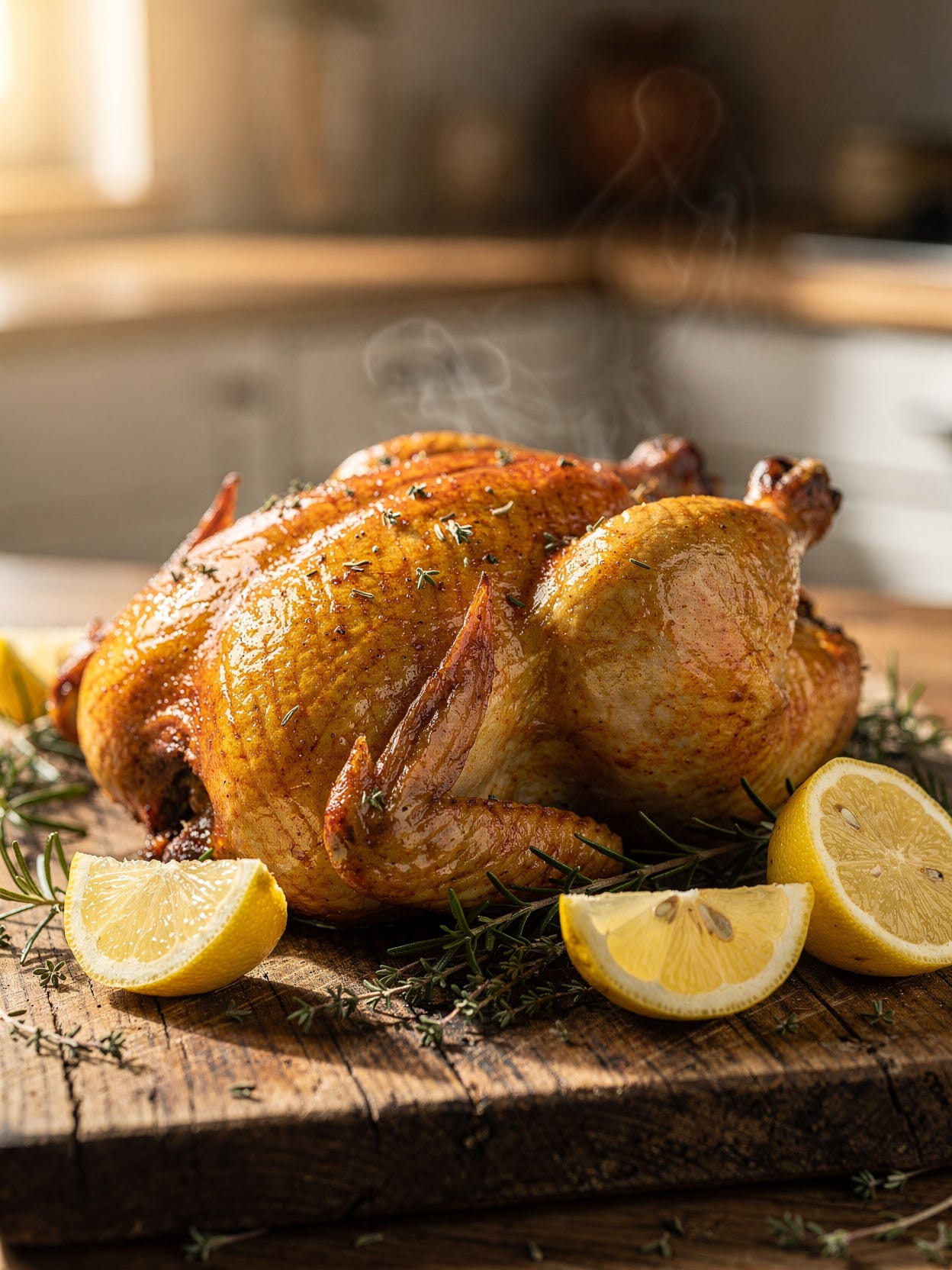
This week I’m walking through the system I use every Sunday from October to May.
What a $5 rotisserie can’t give you
The plastic dome at the grocery store is a steamer, not a roaster. That’s why rotisserie skin is rubbery instead of crackling. Most are also injected with a sodium-phosphate solution — sometimes 15% of the bird’s weight by the time it hits the warmer. The carcass goes in the trash. The pan drippings don’t exist.
When you cook a 4–5 pound bird at home with two techniques home cooks rarely get taught, you get all of that back: shatter-crisp skin, clean ingredients, real fond for sauce-building, and a carcass capable of producing two quarts of gelatin-rich stock. The stock alone is worth $6 against store-bought.
The Whole-Bird Method
Three techniques do all the work.
Spatchcock. Backbone removed with kitchen shears, bird pressed flat. Now every part of the chicken sits at the same distance from the heat source — breasts and thighs finish at the same time, no more dry breast meat chasing thigh doneness. Roasting time drops from over an hour to about 40 minutes at 450°F.
24-hour dry brine. 1 teaspoon kosher salt per pound, applied to dry skin, rested uncovered on a rack in the fridge. The salt pulls moisture to the surface, then the meat reabsorbs it carrying salt deep into the muscle. Crucially, the skin dehydrates overnight. Dry skin browns. Wet skin steams.
Carcass economy. Backbone, wing tips, neck, and skin scraps go straight into a freezer bag. Saturday morning, they go into a stockpot with $1 of vegetables. Cold water start. Three-hour gentle simmer. Never boil — boiling emulsifies fat into the stock and turns it cloudy. What you get is a clear, gelatin-rich stock that turns soft jelly when chilled. That jiggle is the difference between homemade and store-bought

.
How one bird becomes five dinners
Sunday: pull the bird out, dry brine. Monday: roast it. The breasts get carved and saved cold. The thighs get sliced. Every bone goes into a freezer bag.
Tuesday is Spring Green Goddess Tacos with the cold breast meat — herb-loaded yogurt sauce, quick-pickled radishes, peas, avocado. Don’t reheat the chicken. Cold breast meat is what makes Tuesday feel like a different meal instead of a leftover.
Wednesday is Crispy Gnocchi with Chicken and Leeks. The two tablespoons of pan drippings you saved from Monday goes into the leek pan. That fond is restaurant-level depth — there’s no substitute. Finish with cold butter off heat. That’s mounting, the same emulsification technique pan sauces use, and it’s why the sauce looks glossy instead of broken.
Thursday is the Fridge-Dump Spring Cobb — whatever’s left, blanched asparagus, hard-boiled eggs, the leftover green goddess as dressing. Compose, don’t toss. Each bite hits a different combination.
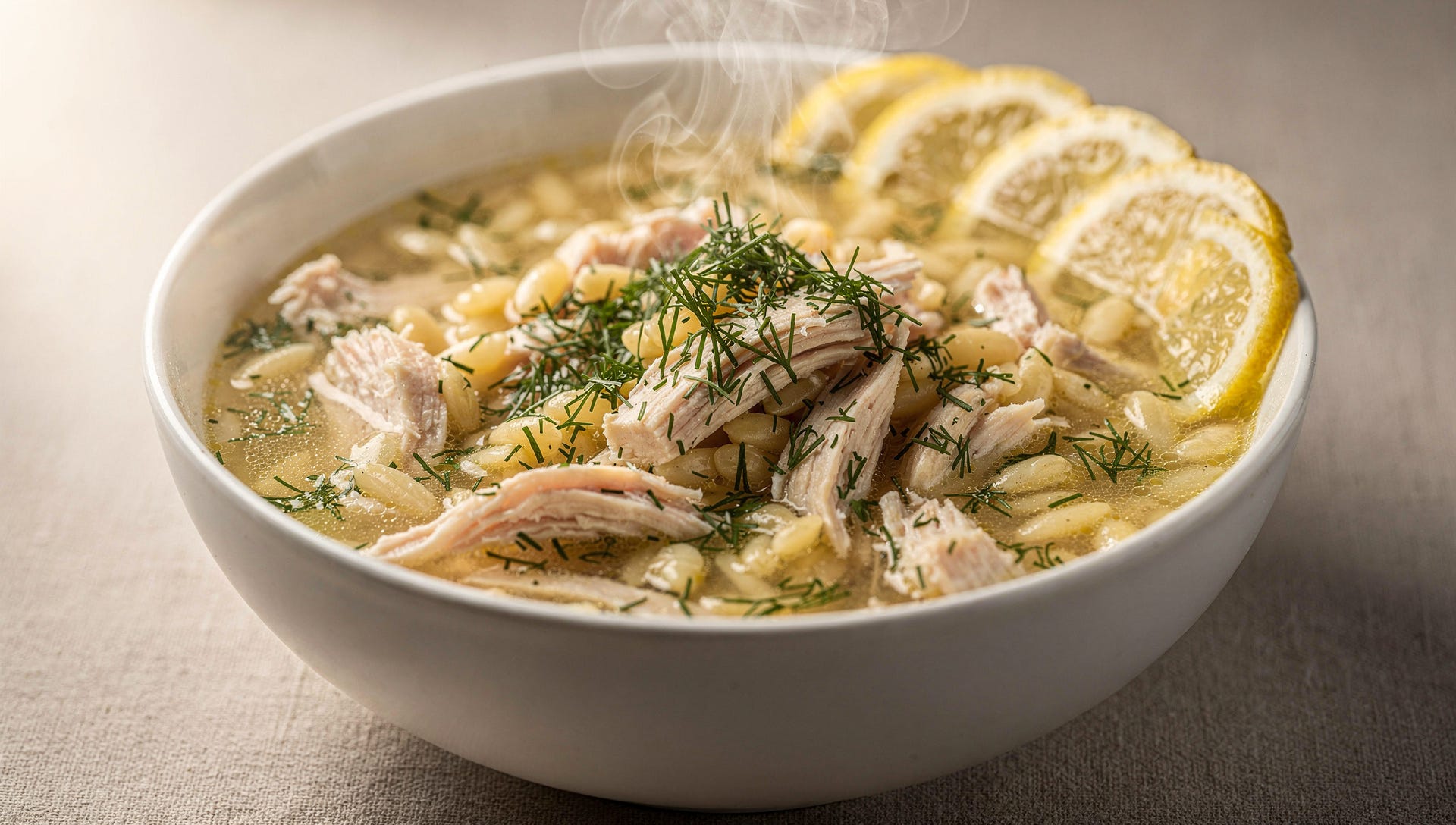
Friday is Avgolemono — Greek lemon-chicken-orzo soup, built on the homemade stock you made Saturday. You temper eggs with lemon and hot broth, pour the mixture back, and it transforms a simple soup into something silky. Store-bought broth makes this dish taste flat. The carcass economy is what makes it taste like a restaurant.
Five dinners × four servings = 20 plates at $2.30 each. Including a Friday soup that uses $0 worth of stock you would otherwise pay $6 for.
Master the method, not the recipe
The Whole-Bird Method isn’t really about chicken. It’s about the architecture underneath every professional kitchen: one protein prepped properly becomes a week of meals; the technique is the asset, not the ingredient; the scraps home cooks throw away are where restaurants make their money.
Spatchcock anything. Dry brine anything. Build stock from anything. These three skills work on turkey, duck, Cornish hens, and any roasting bird you’ll ever cook again.
The full packet — every recipe, the spatchcock walkthrough, the stock method, the cost breakdown — is below.
Cook once. Eat all week. Here’s how I do it.
— Tyler
Reply and tell me: what do you do with the carcass right now? Throw it out, freeze it, or already making stock? I’m curious where the room to grow is.
P.S. If you’ve never spatchcocked a bird before, the first time takes about 90 seconds with a decent pair of kitchen shears. The second time takes thirty. After that you’ll never roast a chicken any other way.
What You’ll Need This Week
Three tools turn the Whole-Bird Method from a 90-minute project into something you can do half-asleep on a Sunday morning. Here’s what I actually use in my kitchen.
Heavy-duty kitchen shears → The single tool that makes spatchcocking a 30-second job instead of a wrestling match with a chef’s knife. You’re cutting through rib bones, not just skin and cartilage — flimsy shears bend, slip, and turn into a safety problem. Look for spring-loaded shears with a locking mechanism, full-tang blades, and a bone notch near the pivot. They come apart for cleaning, which matters when you’re cutting raw chicken every week. I’ve had the same pair for six years.
Wire rack + half sheet pan → The dry brine doesn’t work without airflow. A bird sitting in its own moisture on a flat sheet pan dehydrates on top and stays clammy underneath — you’ll get patchy skin instead of even crackle. The rack lifts the bird about half an inch off the pan so cold fridge air circulates all around it for 24 hours. Get a heavy-gauge half sheet (not the warped grocery-store ones) and a stainless wire rack that fits inside it. The same setup is what I use for cooling cookies, resting steaks, and roasting vegetables. It earns its drawer space.
Instant-read thermometer → Internal temperature is the whole game. 160°F in the breast, 175°F in the thigh — pull at those numbers and let carryover bring it the rest of the way to 165°F during the rest. A cheap dial thermometer takes 20 seconds to read and is wrong by 10 degrees half the time. A good instant-read gives you an answer in two seconds and is accurate to within a single degree. This is the difference between a juicy bird every time and the guess-and-check approach that gives most home cooks dry breast meat. If you only buy one tool from this list, buy this one.
As an affiliate, I earn from qualifying purchases. These are products I actually use in my own kitchen — your support keeps CulinaryBrief free.