
Most people walk past the best beef in the case. It's not the ribeye. It's not the strip. It's the section right next to both of them — the chuck primal — and it's sitting there at $6–10/lb while the cuts everyone recognizes are running $14–16 right now. I've watched beef prices climb every month this year. The national herd is at its smallest since 1951. That's not going away. So if you're still building your summer grill rotation around ribeye, you're going to feel it. Here's what butchers actually buy for themselves.

THE THREE CUTS NOBODY TALKS ABOUT
The chuck is the shoulder section of the cow. Hard-working muscle, which usually means tough — but butchers have gotten precise about how they break it down. Three cuts inside that primal grill beautifully if you know what you're working with. The Flat Iron comes from the top blade muscle. In a University of Nebraska study ranking every beef cut by tenderness, it came in second — behind only filet mignon. More flavor than filet. Uniform thickness so it cooks evenly. $8–10/lb.
✦ The Denver Steak was discovered in 2009 when a team of professional butchers did a systematic breakdown of the entire chuck looking for hidden value. It had been sitting there unrecognized for decades. Marbled like a New York strip, up to $5/lb cheaper. $8–10/lb.
✦ The Chuck Eye sits directly adjacent to the ribeye on the carcass — same fat distribution, same marbling pattern, same flavor profile. Butchers have called it "the poor man's ribeye" for years, meaning it's the cut they take home themselves. $6–7/lb vs. ribeye at $14–16.
✦ These aren't compromise cuts. They're overlooked cuts. There's a difference. One rule applies to all three: slice against the grain. The muscle fibers in chuck cuts run long and pronounced. Cut with them and it's tough. Cut perpendicular at a 45° angle and it's tender, clean, and restaurant-quality. Look at the steak before you touch it. Identify which direction the fibers run. Cut across them. That's the technique.
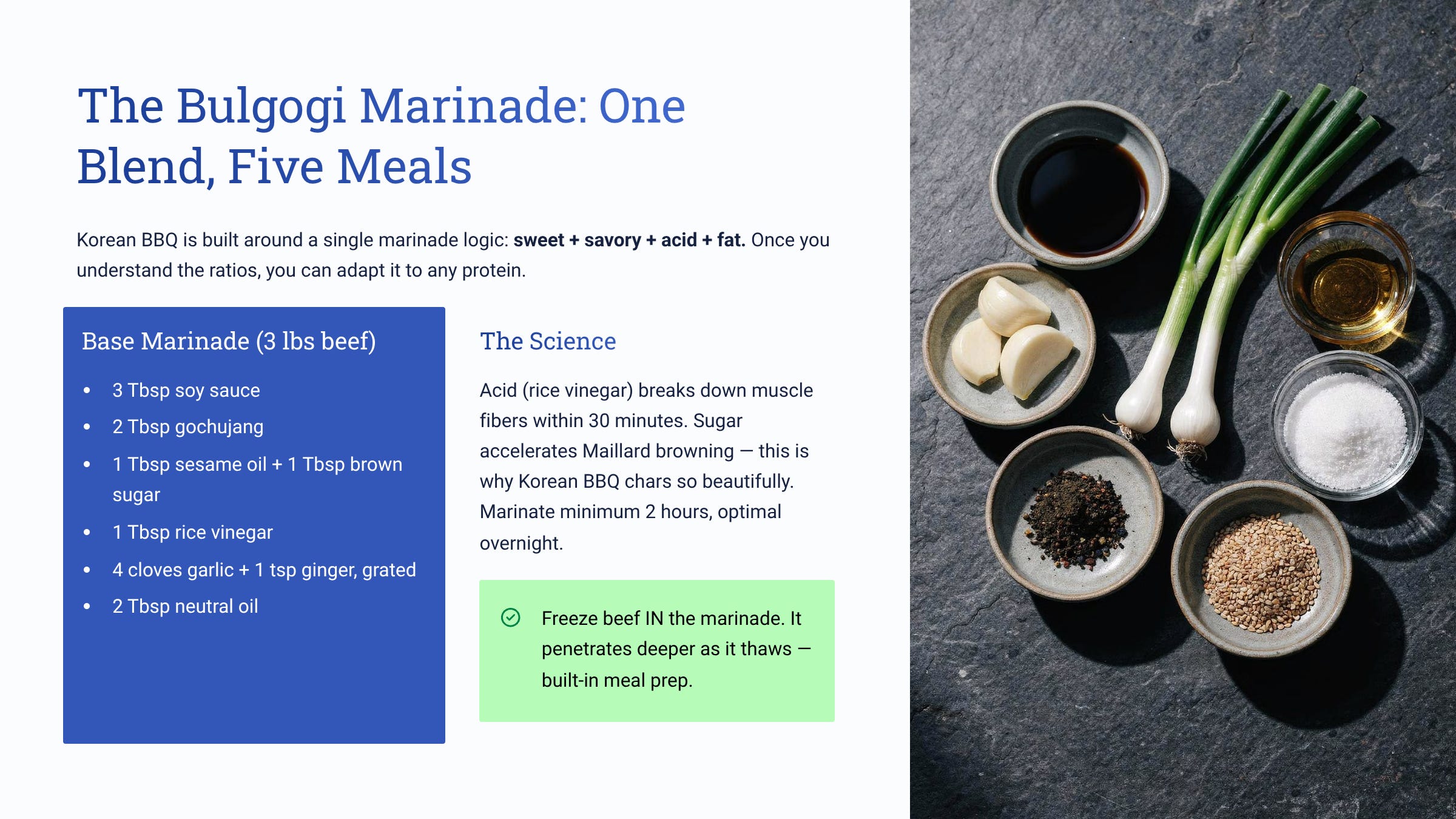
THE KOREAN BBQ SYSTEM This is where it becomes a batch cook. Korean BBQ is built around one marinade logic: fermented heat + sweet + savory + acid. Gochujang — fermented chili paste, not hot sauce — is the backbone. One $4 jar lasts 3–4 months in your fridge.
The Bulgogi Marinade:
3 Tbsp soy sauce 2 Tbsp gochujang 1 Tbsp sesame oil 1 Tbsp brown sugar 1 Tbsp rice vinegar 4 cloves garlic, grated 1 tsp fresh ginger, grated 2 Tbsp neutral oil
Here's the move most people skip: freeze the beef inside the marinade. Put your raw flat iron or Denver steak in a zip bag with the marinade. Flatten it. Freeze it. As the beef thaws, the muscle fibers relax and open — the marinade penetrates deeper than it ever would in a 2-hour fridge soak. You get better flavor with less active time. That's 3 lbs of Sunday grilling sitting in your freezer ready whenever you need it. Thaw overnight in the fridge. Pull it out 30 minutes before grilling so the surface temperature evens out. Pat lightly dry — leave some marinade coating, not a pool of it. Grill over high heat, 3–4 minutes per side. Pull at 125°F internal. Rest 5 minutes on a wire rack. Slice against the grain. That's the whole technique.

--- THE WEEK
One batch of 3 lbs built around flat iron or Denver steak runs $26–30.
✦ That's five nights of dinner for two people at $2.80–$4.20 per serving — depending on what you build around it.
Monday + Tuesday: Korean BBQ Steak Bowls.
Sliced beef over steamed rice, quick-pickled cucumber (salt + rice vinegar + sesame oil, 20 minutes), sriracha mayo, scallions. ~38g protein per serving.
Wednesday + Thursday: Steak Ssam.
Warm beef wrapped in butter lettuce with short-grain rice and ssamjang — doenjang, gochujang, sesame oil, honey, mixed together. Lighter. Faster. Completely different flavor profile from Monday.
Friday: Grilled steak with charred summer squash and gochujang compound butter.
Hold one steak whole and unsliced through the week for this. Reheat 90 seconds per side in a ripping hot cast iron. Melt the compound butter over the top as it rests. Same protein. Five nights. Zero repetition in flavor. ---
What's the one cut you've written off because you didn't know how to cook it? Reply and tell me — I'll tell you exactly what to do with it.
P.S. The freeze-in-marinade method works on chicken thighs, pork shoulder strips, and salmon too. Build the marinade, bag the protein, freeze it. Your future self will thank you on a Wednesday night when you have nothing planned.
Full breakdown — three cuts, the marinade ratios, and the complete
meal system — is in this week's newsletter.