
Everyone’s waiting for January.
“New year, new me.”
“Fresh start on January 1.”
“I’ll get serious after the holidays.”
Here’s what I know from 12 years in professional kitchens:
January 1 with no system is just December 32 with more pressure.
You know what actually works?
Building the system in December.
Not perfectly. Not intensely. Just building it.
I’m not waiting until January. And if you’re tired of January failing you every year, maybe you shouldn’t either.
Why January “Fresh Starts” Fail
The pattern repeats every single year:
December: Chaos, survival mode, “I’ll start in January”
January 1: Strict plans, high motivation, all-or-nothing thinking
January 15: Plan abandoned, back to square one
February: “Maybe I’m just not a meal prep person”
The problem isn’t you.
The problem is: You’re trying to build a house without a foundation.
You can’t install a system on motivation alone. You need repetition. You need practice. You need to actually try things and see what works for YOUR life—not Instagram’s idea of meal prep, not some influencer’s “perfect” system.
And you can’t figure that out in two weeks while you’re also adjusting to post-holiday reality, returning to work routines, and dealing with the psychological weight of “new year new me.”
You do it now. In December.
When stakes are low.
When you can experiment.
When “failure” is just data, not identity.
Let Me Be Clear About Something
I reject hustle culture.
I reject 4-hour meal prep marathons.
I reject the idea that you need to be productive every waking moment.
I reject content that glorifies burnout as a badge of honor.
But I don’t reject effort.
And I’m tired of the current trend that treats ANY effort as toxic.
“Give yourself grace” has morphed into code for “don’t try.”
“Self-care” has become permission to never do hard things.
“Low-effort living” sounds appealing until you’re stressed every single night at 6pm with no plan.
There’s a difference between toxic hustle culture and intentional, consistent effort toward something that actually matters to you.
Let me show you what I mean:
Hustle culture says: Grind 24/7. Optimize every moment. Sleep is for the weak. Burnout is success.
Intentional effort says: Do this one thing consistently. Build a system that gives you your life back, not one that consumes it.
Batch cooking for 30-45 minutes on Sunday is effort.
Showing up consistently even when you don’t feel motivated is work.
Building a system and iterating until it fits your actual life does require trying.
The difference?
Hustle is unsustainable effort that leads to burnout.
Intentional effort is sustainable work that creates freedom.
I teach the second one.
You Get to Choose Your Hard
Here’s the truth nobody wants to say:
It’s hard to batch cook on Sunday when you’d rather relax.
It’s also hard to stand in front of your fridge at 6pm every night, exhausted, with no idea what to make, scrolling through delivery apps you can’t really afford while your blood sugar crashes and your stress compounds.
You don’t get to choose “not hard.”
You get to choose WHICH hard.
Hard now, ease later.
Or ease now, hard later.
I’m not telling you which to choose. I’m telling you: You ARE choosing, whether you realize it or not.
Every Sunday you skip = choosing weeknight decision fatigue
Every Sunday you show up = choosing weeknight ease
Neither choice is wrong. But be honest about the choice you’re making.
And if you’re tired of the daily 6pm panic, if you’re exhausted from deciding what to cook every single night, if you’re frustrated with yourself for ordering takeout again when you said you wouldn’t...
Maybe it’s time to choose the other hard.
The Real Self-Care Question
Self-care culture tells you rest is always the answer.
Bubble baths. Permission to do nothing. Gentle everything.
And sometimes? That IS the answer.
But sometimes—and this is what nobody wants to hear—real self-care is doing the thing that Future You will thank you for.
Self-care is also:
Cooking on Sunday so you’re not stressed Tuesday
Building a system so you don’t hate yourself at 6pm
Putting in 45 minutes of effort now so you have five hours of freedom later
This isn’t “no pain no gain” toxic positivity.
This is: Which version of hard actually serves you?
The hard of building something? Or the hard of scrambling every single day?
Discipline isn’t punishment. Discipline is caring about Future You.
Structure doesn’t restrict freedom. Structure CREATES freedom.
How You Actually Find What Works
“What’s the BEST meal prep system?”
There isn’t one.
There’s the one that works for your schedule, your kitchen, your preferences, your family, your skill level, your energy patterns, your budget, your life.
And you only find it by trying things.
Not by thinking about it.
Not by reading 47 blog posts.
Not by waiting for perfect clarity.
By doing. By experimenting. By collecting data.
Most people wait for the perfect system to reveal itself before they start.
Perfect clarity comes from DOING, not thinking.
Try this week’s approach. See how it feels.
Maybe it works great. Keep it.
Maybe you hate it. Good—now you know. Try something different next week.
Maybe parts work and parts don’t. Adjust. Iterate. That’s how systems are built.
You’re not committing forever. You’re experimenting.
And every experiment—even the “failed” ones—gives you information about what DOES work for you.

Why December, Not January
Why start building in December instead of waiting for January?
1. Lower psychological stakes
December is already chaotic. One more experiment doesn’t add much pressure. If Sunday meal prep doesn’t happen because of holiday chaos, it’s just “oh well, December is crazy.”
January has resolution weight. Every “failure” feels like proof that you can’t do it, that you’ll never figure it out, that you should just give up.
December experimentation = low stakes data collection.
2. You need multiple repetitions to know if something works
One Sunday of meal prep doesn’t tell you if the system works. You need 3-4 weeks to actually know.
Start in December = 4 weeks of real data by the end of January.
Start in January = still figuring it out through February.
3. January becomes easy if you already have a system
If you have a working system by January 1, January is just... continuation.
No dramatic fresh start needed.
No motivation required.
No willpower involved.
Just: keep going with what’s already working.
That’s sustainable.
4. You’re cooking anyway
You’re making dinner in December whether you plan it or not.
Dinner is happening. The meals exist. You’re spending time on food one way or another.
Why not make that time intentional?
Why not use it to build toward something?
Why not collect data while you’re doing the thing you’d be doing anyway?
The meals are happening regardless. Might as well use them to build a system.
This Week: An Experiment
So here’s what I’m proposing:
Not a January resolution.
Not a dramatic life overhaul.
Not a commitment to meal prep forever.
Just: an experiment to try this week.
This week’s approach is different from what I typically teach. I’m showing you a different method because the whole point is: try things until you find what works for YOU.
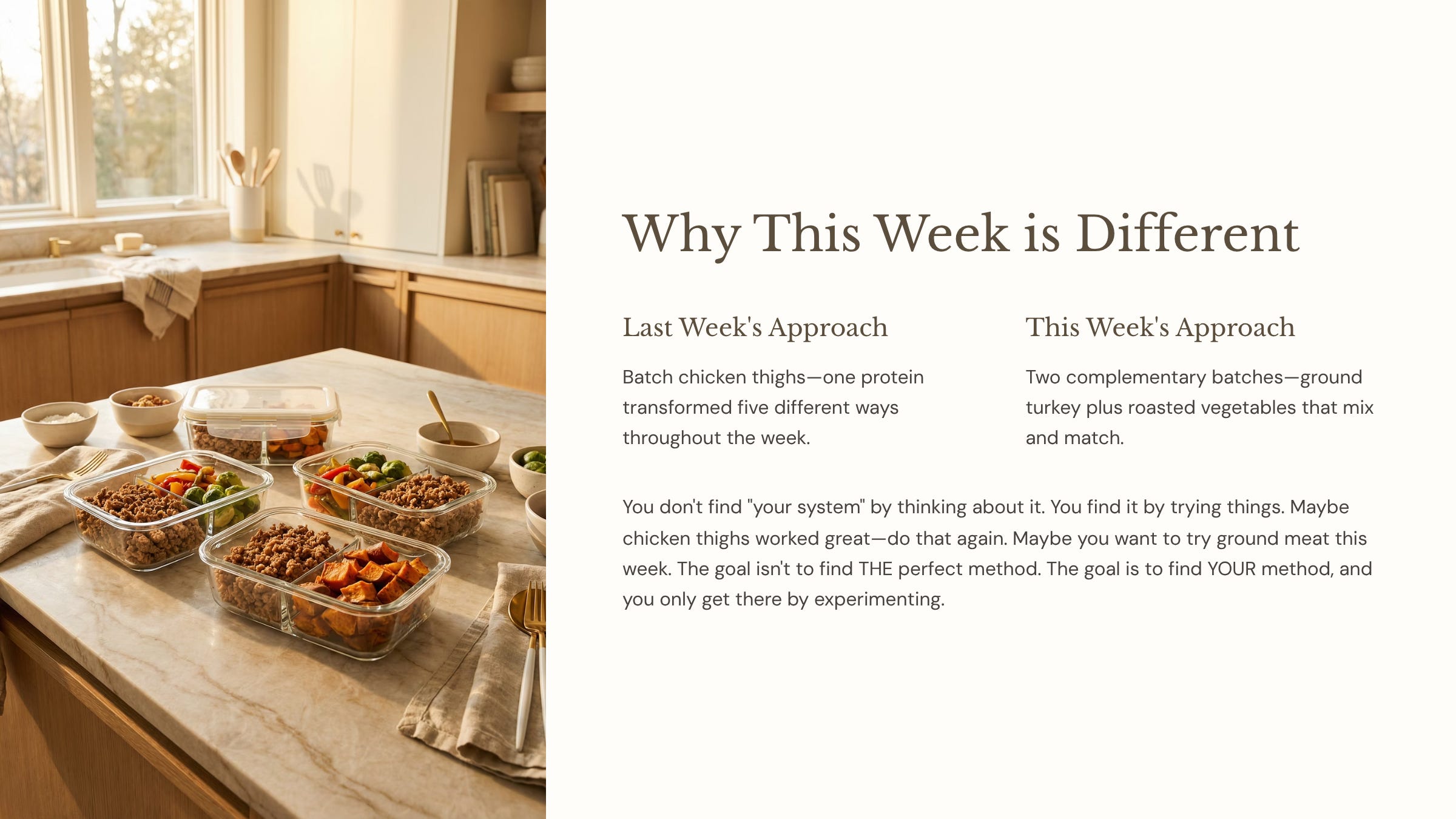
Last week (if you followed along): One protein batch, five different transformations. That’s the classic method.
This week: Two batches (ground turkey + roasted vegetables), mix and match throughout the week.
Why the change? Because you need to TRY different approaches to find your method.
Maybe one protein batch worked great for you. Awesome. Do that again.
Maybe you want to try ground meat this week instead of whole cuts. Here’s how.
Maybe next week you’ll try lentils, or Wednesday prep instead of Sunday, or even cooking fresh with just a solid plan.
The goal isn’t to find THE perfect method. The goal is to find YOUR method.
And you only get there by experimenting.
Sunday Prep: Two Batches, 45 Minutes
This week you’re batching two components that mix and match:
Batch 1: Ground Turkey (20 minutes active)
2 lbs ground turkey
Season while cooking
Cool and store (half fridge, half freezer)
Batch 2: Sheet Pan Vegetables (25 minutes, mostly hands-off)
Bell peppers, onions, zucchini, sweet potato
Roast at 425°F
Cool and store
Total Sunday time: 45 minutes with overlap
Why ground turkey instead of chicken thighs?
Ground meat cooks faster. 20 minutes vs 30 minutes. Different texture. Different applications. Maybe it works better for you. Maybe it doesn’t. That’s the data you’re collecting.
Why add a vegetable batch?
Because roasted vegetables work in everything. Having them ready removes another decision point during the week. Maybe that extra 10 minutes on Sunday is worth it. Maybe it’s not. Try it and see.
Here’s what you’re testing:
Can you show up for 45 minutes on Sunday?
Does this approach feel more or less sustainable than one protein batch?
Do you like working with ground meat or do you prefer whole cuts?
Does having vegetables ready make weeknights easier?
These aren’t hypothetical questions. These are things you only learn by doing.
The Five Meals: Different Approaches, Same Foundation
Here’s where those two batches go:
Monday: Turkey Taco Bowls (10 minutes)
Restaurant-style burrito bowls. All your batch components come together.
Why this matters: This is what Sunday effort gets you. Ten minutes from fridge to table. Restaurant quality at home. This is the payoff for showing up on Sunday.
Rice, beans, your batch turkey with taco seasoning, roasted vegetables, all the toppings. Easy, satisfying, complete.
Tuesday: Turkey Stuffed Peppers (35 minutes, mostly passive)
Ground turkey, rice, roasted vegetables, stuffed into peppers with cheese and baked.
Why this matters: Day 2, the system is still working. You’re using what you already prepped but making something that feels completely different from Monday. Classic comfort food, slightly more involved, still manageable.
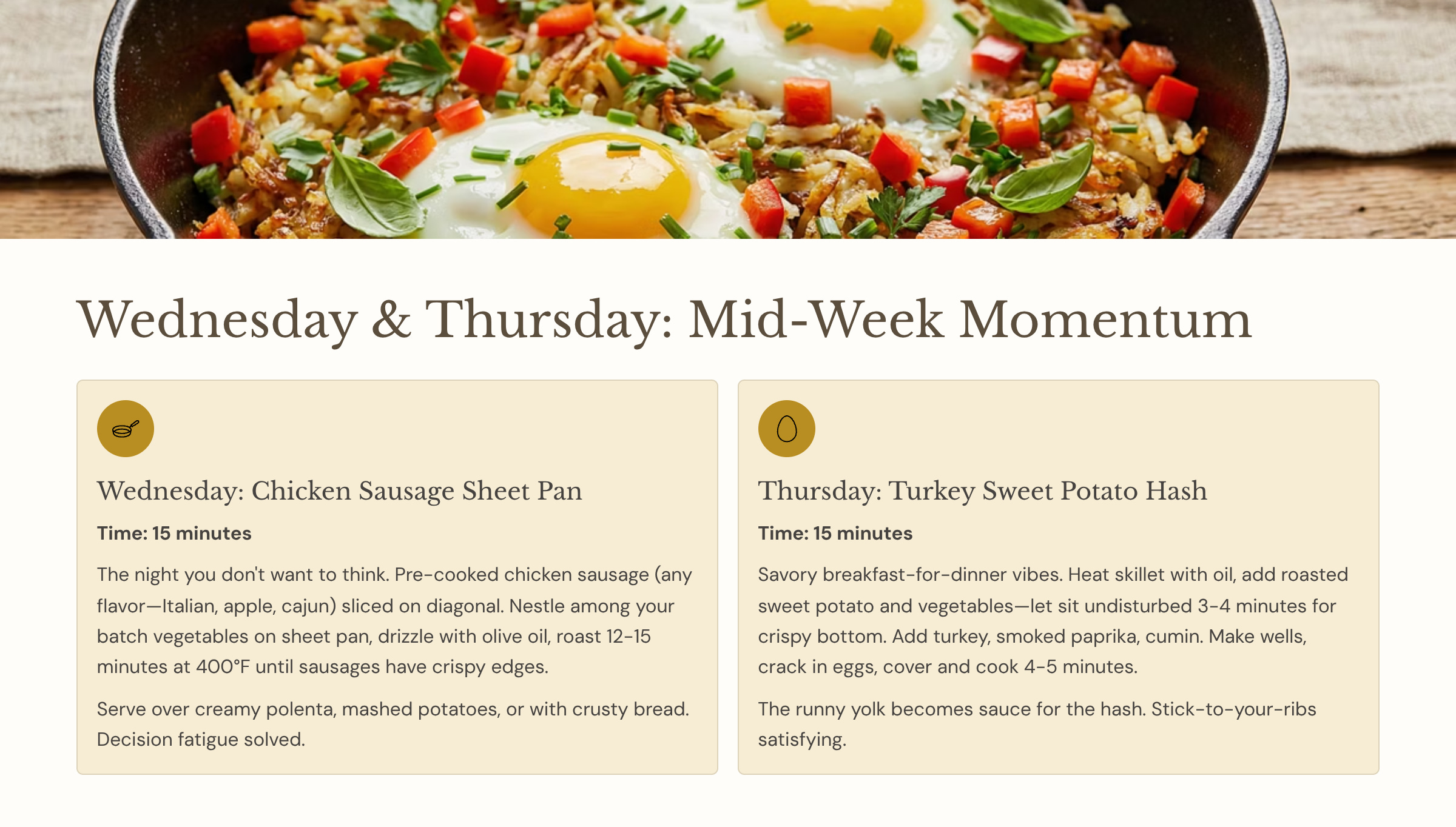
Wednesday: Chicken Sausage & Vegetables (15 minutes)
Pre-cooked sausage + your roasted vegetables, reheated together on a sheet pan.
Why this matters: By Wednesday, decision fatigue is real. This meal requires almost zero thinking. The sausage is pre-cooked (just heating and crisping). Your vegetables are already roasted. You’re assembling, not cooking.
Real talk: Some weeks, Wednesday might be pizza night instead. That’s fine. That’s REAL life. The system allows for that. One day off doesn’t break consistency. Thursday you just show up again.
This is the difference between January resolutions (all-or-nothing) and December foundations (sustainable systems).
Thursday: Turkey & Sweet Potato Hash (15 minutes)
Ground turkey, roasted sweet potato, eggs. Skillet meal with breakfast-for-dinner vibes.
Why this matters: If Wednesday was pizza, Thursday is where you prove consistency isn’t perfection. You just show up again. No guilt. No “starting over.” Just continuing.
The batch is still there. The system still works. You didn’t fail. You just had a day off.
Friday: Turkey Lettuce Wraps (10 minutes)
Light, fresh, customizable. Build-your-own style. Use up what’s left.
Why this matters: By Friday, you’re not following a strict recipe. You’re improvising with what you have. You’re using the remaining batch turkey, adding fresh toppings, making it work.
This is what happens when you show up consistently—you get better without trying. You develop instincts. You start creating instead of just following instructions.
That’s mastery.
What This Week Actually Tests
This isn’t just about making five dinners.
This is about collecting data on what works for YOUR actual life.
Questions you’ll answer by doing this:
Can I show up for 45 minutes on Sunday?
Maybe yes. Maybe you need a shorter batch. Maybe you need a different day. You only know by trying.
Do I prefer ground meat or whole cuts?
Some people love ground meat (faster, more versatile). Some people prefer whole cuts (different texture, feels more “meal-like”). Neither is wrong. Which do YOU prefer?
Does batching vegetables actually help?
Maybe having them ready saves you tons of time. Maybe you’d rather chop fresh. Try it and see.
What happens when I skip a day?
If Wednesday is pizza night, does Thursday feel impossible or does the system make it easy to continue? This is crucial data.
By Friday, am I bored or am I flowing?
If you’re bored, you need more variety or a different system. If you’re flowing and improvising, the system is working.
These answers don’t come from thinking. They come from doing.
The Recipes Are Just Evidence
Here’s the thing: This post isn’t really about the recipes.
The recipes are evidence that the thesis works. They’re proof of concept. They’re the practical application of the idea.
But the IDEA is what matters:
You don’t build sustainable systems by waiting for perfect conditions. You build them by trying imperfect things right now.
The meals this week are simply: a specific thing to try. A concrete experiment. A way to collect data.
You could batch chicken thighs instead. You could try lentils. You could prep Wednesday instead of Sunday. You could cook fresh every night with a solid plan.
The SPECIFIC method matters less than the PRINCIPLE:
Consistent effort, applied to a system you’re iterating, compounds into something that actually works for your life.
That’s what I’m asking you to try.
Not meal prep.
Not my exact system.
Not someone else’s perfect method.
Just: try SOMETHING this week. See what happens. Adjust based on what you learn.
That’s how you build a foundation.
Why This Matters More Than You Think
December dinner is happening whether you plan it or not.
You’re going to eat. You’re going to spend time on food. You’re going to make decisions about meals one way or another.
The question isn’t: Should I engage with this?
The question is: Should I make it intentional?
Right now, you’re probably:
Deciding what to cook every single night
Scrolling delivery apps when you’re too tired
Making multiple grocery runs because you forgot things
Throwing away food that went bad
Feeling guilty about choices you made under stress
That’s a system. It’s just not a good one.
You’re already spending the time. You’re already spending the money. You’re already dealing with the stress.
What if you redirected that effort into building something that actually serves you?
45 minutes on Sunday.
Five easier weeknights.
Data on what works for you.
Foundation for January.
It’s not additional effort. It’s redirected effort.
Same time. Same energy. Better outcome.
What Happens If You Try This
Best case scenario:
You try this week’s system. It works. You feel less stressed. Dinner stops being a daily crisis. You have a method that fits your life. You keep doing it.
By January, you’re not starting. You’re continuing.
By February, you’re not quitting. You’re adjusting.
By March, you’re not “trying to get back on track.” You’re just living.
Worst case scenario:
You try this week’s system. It doesn’t work. You learn that ground turkey isn’t your thing, or 45 minutes on Sunday is too much, or you need a different approach entirely.
Good. Now you have data. Try something different next week.
The “failure” moved you forward because now you know what DOESN’T work. That narrows the search for what does.
Most likely scenario:
You try this week’s system. Parts work. Parts don’t. You adjust. You iterate. You keep what works, change what doesn’t.
You learn that:
Ground turkey is great but you need more variety
Or Sunday prep works but 45 minutes is too long, trim it to 30
Or the meals are good but you need different cuisines
Or Wednesday does need to be an easy-out option
And you use that information to build YOUR system.
That’s how it actually works. Not perfect from day one. Iterative. Experimental. Improving through practice.
The Real Question
Here’s what I want you to ask yourself:
If you wait until January, what will be different?
Will you magically have more time? No.
Will you suddenly have more motivation? Maybe, for two weeks.
Will the system be easier to build? No, actually harder—more pressure.
Or will it be the same pattern as every year?
Big plans. High expectations. Intense effort. Inevitable burnout. Back to square one.
What if instead, you:
Started small.
Started now.
Built gradually.
Iterated based on real data.
Arrived at January with a working system instead of empty motivation.
You don’t need a fresh start. You need a foundation.
And foundations aren’t built in one dramatic January morning. They’re built through consistent December efforts.
This Week’s Experiment
I’m not asking you to commit to meal prep forever.
I’m not asking you to follow my system exactly.
I’m not asking you to be perfect.
I’m asking you to try one thing this week.
Batch two components on Sunday. Use them in five different ways. See how it feels.
If it works, do it again next week.
If it doesn’t work, try something different next week.
Either way, you’re further than you were.
No waiting for January.
No “fresh start” needed.
Just: try this week. Collect data. Keep building.
Want the complete guide?
Download the full meal plan with:
Complete shopping list (organized by store section)
Detailed instructions for every recipe
Storage and reheating guide
Substitutions for every dietary need
Chef’s notes throughout
Or just save the recipe cards above and try it your way. That’s the whole point—find what works for YOU.
Final Thoughts
Everyone’s waiting for January.
Permission to rest.
Permission to indulge.
Permission to “start later.”
Here’s different permission:
Permission to try now.
Permission to put in effort.
Permission to build something before everyone else does.
Because here’s what happens when you start in December:
By January, you’re not starting. You’re continuing.
By February, you’re not quitting. You’re adjusting.
By March, you’re not “trying to get back on track.” You’re just living.
That’s the difference between January resolutions and December foundations.
One is motivation-dependent.
One is system-dependent.
I know which one works.
So here’s the question:
Are you waiting for January?
Or are you building something now?
I’m not waiting.
See you next Thursday with another approach to try.
— CulinaryBrief
P.S. Really—try this week. Even if it’s imperfect. Even if you only do three of the five meals. Even if Sunday turns into Monday. Even if Wednesday becomes pizza night.
Try something. Collect data. Keep building.
That’s how systems are actually built. Not perfectly. Iteratively.
Start now.
P.P.S. If you try any of these meals this week, reply to this email or comment below and tell me how it went. What worked? What didn’t? What would you change?
I read every single response. Your feedback directly shapes what I create next.
Let’s build this together.