
Your green vegetables don’t turn army green because you’re a bad cook.
They turn army green because heat strips magnesium out of the chlorophyll molecule — converting it to pheophytin, a dull olive compound — and you left them in the pot long enough for that reaction to complete. It’s chemistry, not judgment. And once you understand it, you fix it permanently in about 90 seconds.
That’s what this week is about. Not recipes. A system.
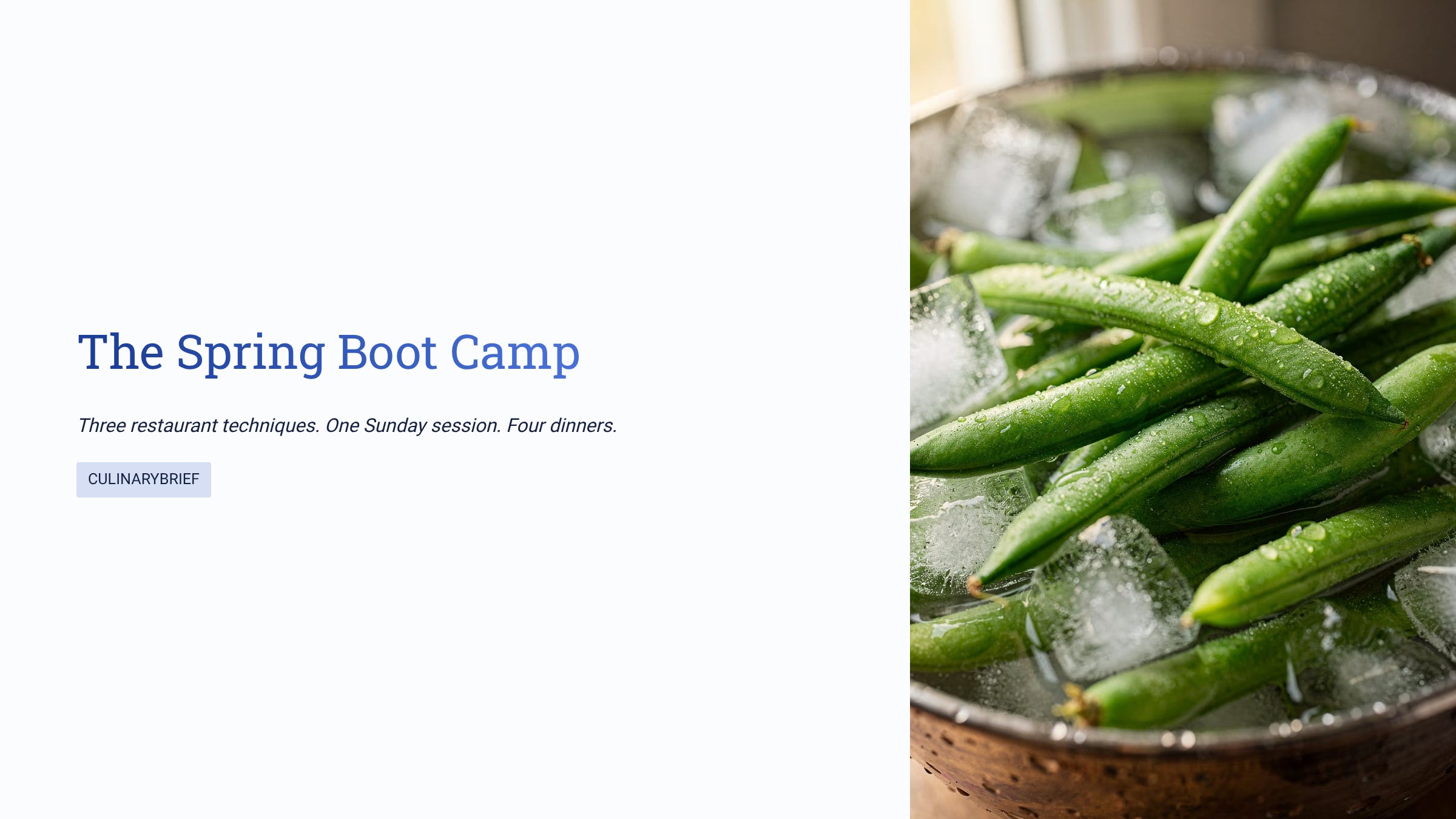
Here’s what professional kitchens actually do with vegetables.
Restaurants don’t cook vegetables to order from raw. A prep cook comes in at 10 AM, runs the morning mise en place, and blanches, pickles, or par-roasts every vegetable before service starts. By 5 PM, when the line is in the weeds on 200 covers, the cook isn’t cooking vegetables — they’re finishing them. Thirty seconds in a hot pan, seasoned, plated. That’s the efficiency gap between a restaurant kitchen and a home kitchen, and it’s entirely replicable on a Sunday afternoon.
It’s the middle of May. Florida’s spring produce window — bell peppers at $1.50/lb, zucchini at $1.34/lb, yellow squash at $1.54/lb, snap beans near peak — closes hard in about six weeks when summer heat drops crop variety off a cliff. This is the window. Here’s the system.
Technique 1: Blanch
Blanching is a par-cook. You’re not cooking the vegetable through — you’re locking it at its best and stopping it there.
The setup: 1 gallon of water per pound of vegetables. That ratio is non-negotiable. A small pot stalls below boiling when you add cold vegetables, and the moment the boil drops, two enzymes — peroxidase and lipoxygenase — stay active and start degrading chlorophyll. At a rolling boil, both are denatured in under 60 seconds. Salt the water to 1%: 1 tablespoon Diamond Crystal kosher per quart. Salt at this concentration penetrates the cell wall by ionic diffusion, seasoning the vegetable through — not just the surface.
Before the vegetables go in, build your ice bath. Equal parts ice and water. Size it to fully submerge everything. This is ready before the first piece hits the pot.
Timing for what’s peak right now: snap beans, 2 minutes. Asparagus spears, 60–90 seconds. Sugar snap peas, 30–45 seconds. Pull at the first vivid flash of color — that’s the moment the intercellular air has expelled and the cell walls have set. Transfer immediately to the ice bath and hold for the same amount of time they cooked. Carryover heat finishes cooking the vegetable after it leaves the water. The ice bath stops it at the exact second you want.
Result: vegetables that hold for 4 days refrigerated without losing color, texture, or flavor. On weeknights, they go from the fridge into a hot skillet with olive oil for 45 seconds. That’s a restaurant side dish.
Technique 2: Quick Pickle
Acid is the most underused component in home kitchens. Restaurants build it on Sunday and deploy it all week — not as a condiment, as a component.
The brine I use: 1 cup white wine vinegar, 1 cup water, 2 tablespoons sugar, 1 tablespoon kosher salt. Bring to a simmer until dissolved. Pour hot over thinly sliced vegetables packed into a jar. That’s it.
The science is osmosis. Your brine is hypertonic — higher in dissolved salt and acid than the inside of the vegetable cell. Water leaves the cell to equalize, and acid, salt, and flavor diffuse in. The cell loses turgor pressure. That’s the dense, snappy, translucent texture of a properly pickled vegetable. Hot brine poured over thinly sliced red onion or bell pepper is ready in 30 minutes. It holds in the fridge for 4 weeks without degrading.
Use white wine or rice vinegar — both run 5% acidity, the minimum threshold to reliably drop the brine below pH 4. Below that line, spoilage organisms can’t survive. Skip iodized table salt; it clouds the brine and leaves a metallic edge. Use kosher or sea salt.
One jar of pickled red onion and one jar of pickled bell pepper built on Sunday will go into 5 different meals before Thursday without any additional work.
Technique 3: High-Heat Roast
The reason your roasted vegetables steam instead of caramelize is almost always the same: the pan is too crowded, the oven isn’t hot enough, or both.
Here’s the wall: water boils at 212°F. The Maillard reaction — the browning chemistry that creates flavor — begins at 285°F. As long as the surface of your vegetable is wet with its own released moisture, that surface temperature is capped at 212°F. You cannot brown a wet surface. Crowding a sheet pan traps steam between the pieces. The oven becomes a steamer. The vegetables come out pale and soft.
The fix is straightforward. For watery spring vegetables — zucchini, summer squash, bell peppers, asparagus — set the oven to 450°F. For medium-density vegetables like eggplant and snap beans, 425°F. Single layer, mandatory. One inch of space between pieces. Use 1 tablespoon of oil per pound of vegetables. Less than that and the surface dries out before it browns; more and you’re frying in a puddle. Preheat the sheet pan empty in the oven for 5 minutes. When the vegetables hit the hot metal, they start dehydrating and browning on contact instead of steaming first.
Zucchini and yellow squash at 450°F: 18–22 minutes, flip once at the 12-minute mark. You’re looking for deep golden color on the cut face. If it’s still pale at 18 minutes, your pan is overcrowded or your oven runs cold.
Reheating: hot dry skillet, medium-high heat, 2 minutes per side. Not the microwave. Microwaves heat by exciting water molecules — they undo every minute of surface dehydration you achieved in the oven.
The Batch System
One Sunday session, about 90 minutes total. Here’s what it produces:
Blanched snap beans → side dish, grain bowl base, cold salad component Blanched asparagus → side dish, egg accompaniment, pasta add-in Quick-pickled red onion → bowl topping, taco garnish, sandwich layer, salad acid Quick-pickled bell pepper → bowl component, grain base, egg topping Roasted zucchini + yellow squash → dinner side, pasta mix-in, grain bowl filler
This week’s batch: ~$16 in produce. Vegetables for 4 dinners, 2 people. That’s $2.00/serving in produce cost.
Per serving, roasted zucchini + snap beans + red pepper: ~110 kcal, ~4g protein, ~5g fiber.
What vegetable do you most consistently overcook? Snap beans, asparagus, or something else entirely? Reply and tell me — I’ll address the specific failure point next week.

P.S. The most skipped step in this whole system is the preheat on the sheet pan. Five minutes of patience before you load it makes a visible difference in the browning. Try it once and you’ll never skip it again.
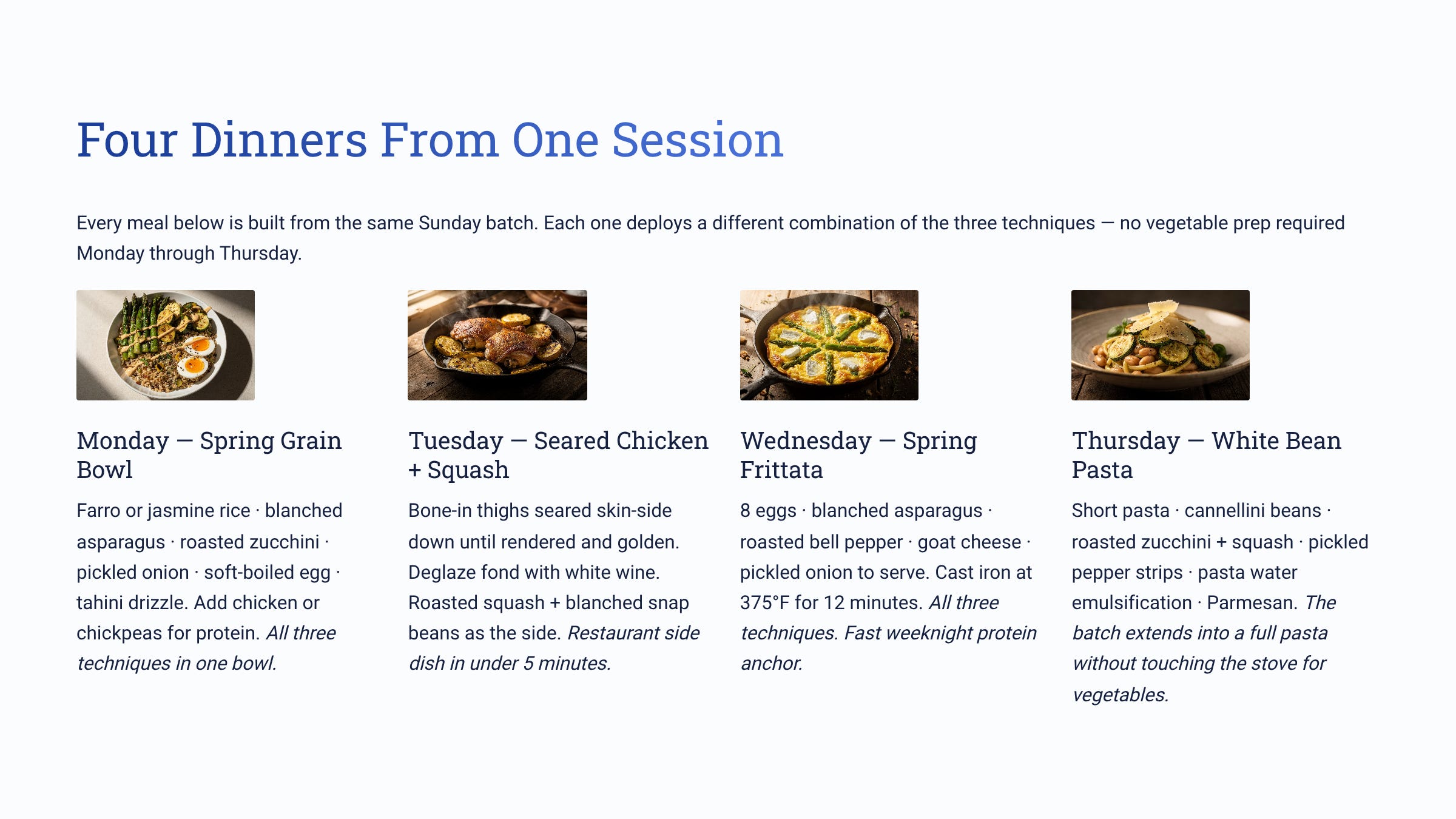
This Week’s Menu
Four dinners. One Sunday session. All vegetables built from the batch above.
Monday — Spring Vegetable Grain Bowl Farro or jasmine rice base, blanched asparagus, roasted zucchini, quick-pickled red onion, soft-boiled egg, tahini drizzle. Add grilled chicken thighs or chickpeas for protein. Technique deployed: blanch + roast + pickle. All three levers in one bowl.
Tuesday — Seared Chicken Thighs with Roasted Squash and Pan Sauce Bone-in chicken thighs seared skin-side down until rendered and golden. Deglaze the fond with white wine. Roasted zucchini and yellow squash as the side, finished in the same skillet with the pan sauce. Blanched snap beans on the side. Technique deployed: roast + blanch. Restaurant side dish in under 5 minutes.
Wednesday — Spring Vegetable Frittata Eight eggs, blanched asparagus, roasted bell pepper (from the pickle jar, drained), goat cheese. Cast iron in the oven at 375°F for 12 minutes. Pickled onion on top to serve. Technique deployed: all three. Fast weeknight protein anchor.
Thursday — White Bean and Roasted Vegetable Pasta Short pasta, cannellini beans, roasted zucchini + squash folded in, pickled bell pepper strips, finished with pasta water and olive oil emulsification. Snap beans halved and added cold. Parmesan to finish. Technique deployed: roast + pickle. The batch extend into a full pasta without touching the stove for vegetables.
Shopping Guide
Produce (peak Florida, May 2026)
ItemAmountEst. CostSnap beans1 lb~$2.50Asparagus1 bunch (~1 lb)~$3.49Sugar snap peas8 oz bag~$3.49Zucchini1.5 lbs~$2.00Yellow squash1 lb~$1.54Red onion2 medium~$1.50Bell peppers (red or mixed)2 large~$3.00Produce total~$17.52
Protein (your choice, not included in batch cost)
OptionAmountEst. CostBone-in chicken thighs2 lbs~$5.00Eggs (1 dozen)12~$3.00Cannellini beans (canned)2 cans~$2.50
Pantry (assume stocked) Diamond Crystal kosher salt, olive oil, white wine vinegar, sugar, farro or jasmine rice, short pasta, tahini, Parmesan.
Total for the week (produce + protein): ~$30–33 for 4 dinners, 2 people = $3.75–4.13/serving.